2026-M07
#2026-M07
I spent the last week of July at PIFcamp in the Soča river valley in Slovenia, where I took the work-in-progress Antennae. So today's Update is mostly a report on what worked, what broke, and how it all glowed in the end ,)
The Body
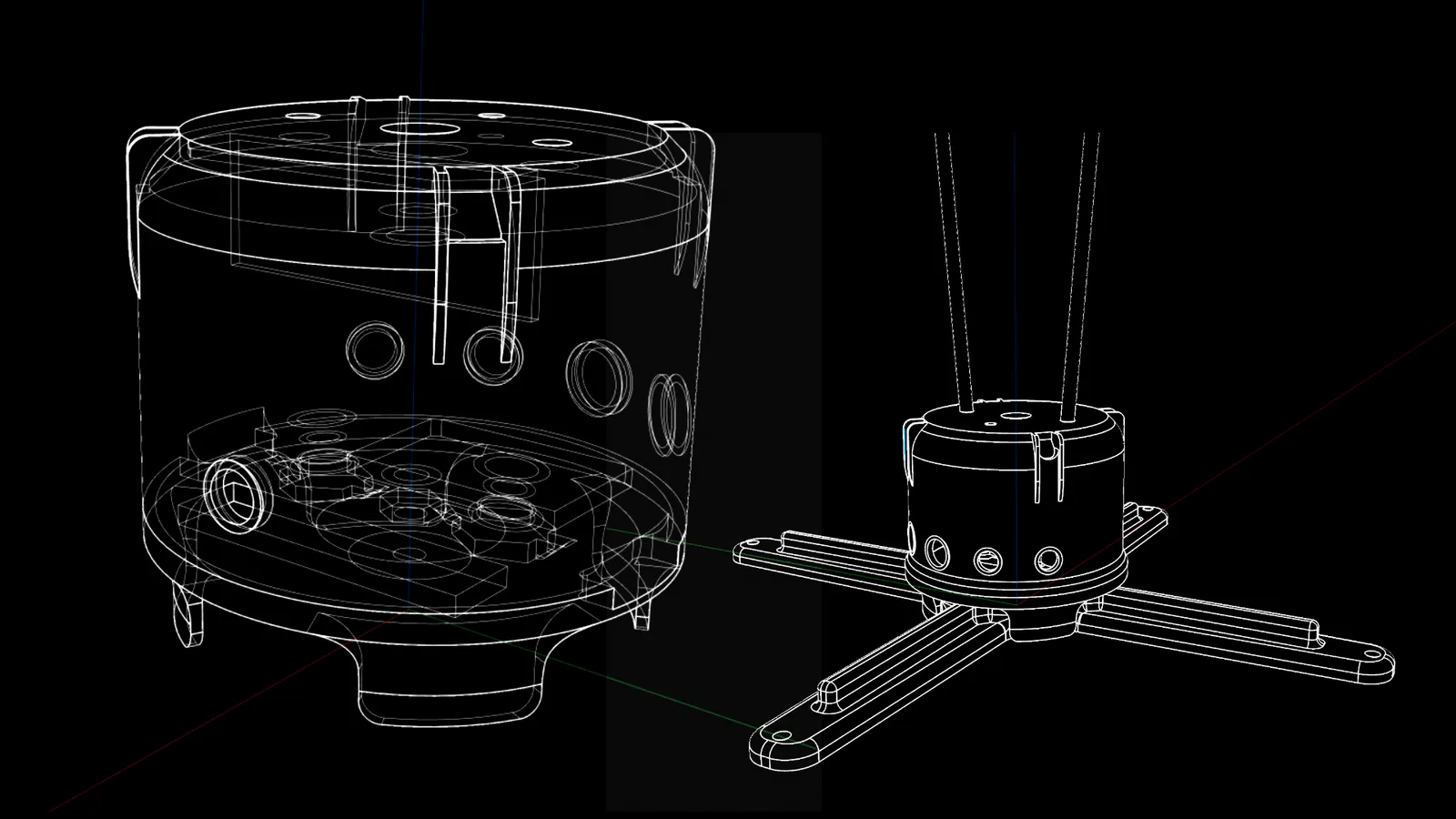
Before leaving for Slovenia I still managed to prepare the body of the object. The shape builds on what I had already tried with the Synapse installation. A low body at the ground, with light-guiding antennae rising out of it. On top of that I ordered a pile of hardware, sensors and the optical PMMA rods themselves, which glow along their full length when lit from below.
The hardware box I printed from carbon fibre PETG, a material I have come to like for its beautiful surface and stiffness. Of course, in the rush I made plenty of mistakes in the first design and had to widen or add some of the openings. To the bottom of the object I fixed a weight, so it could not be tipped over easily. Next time I want the box a bit bigger, simpler to open, and finally waterproof too.
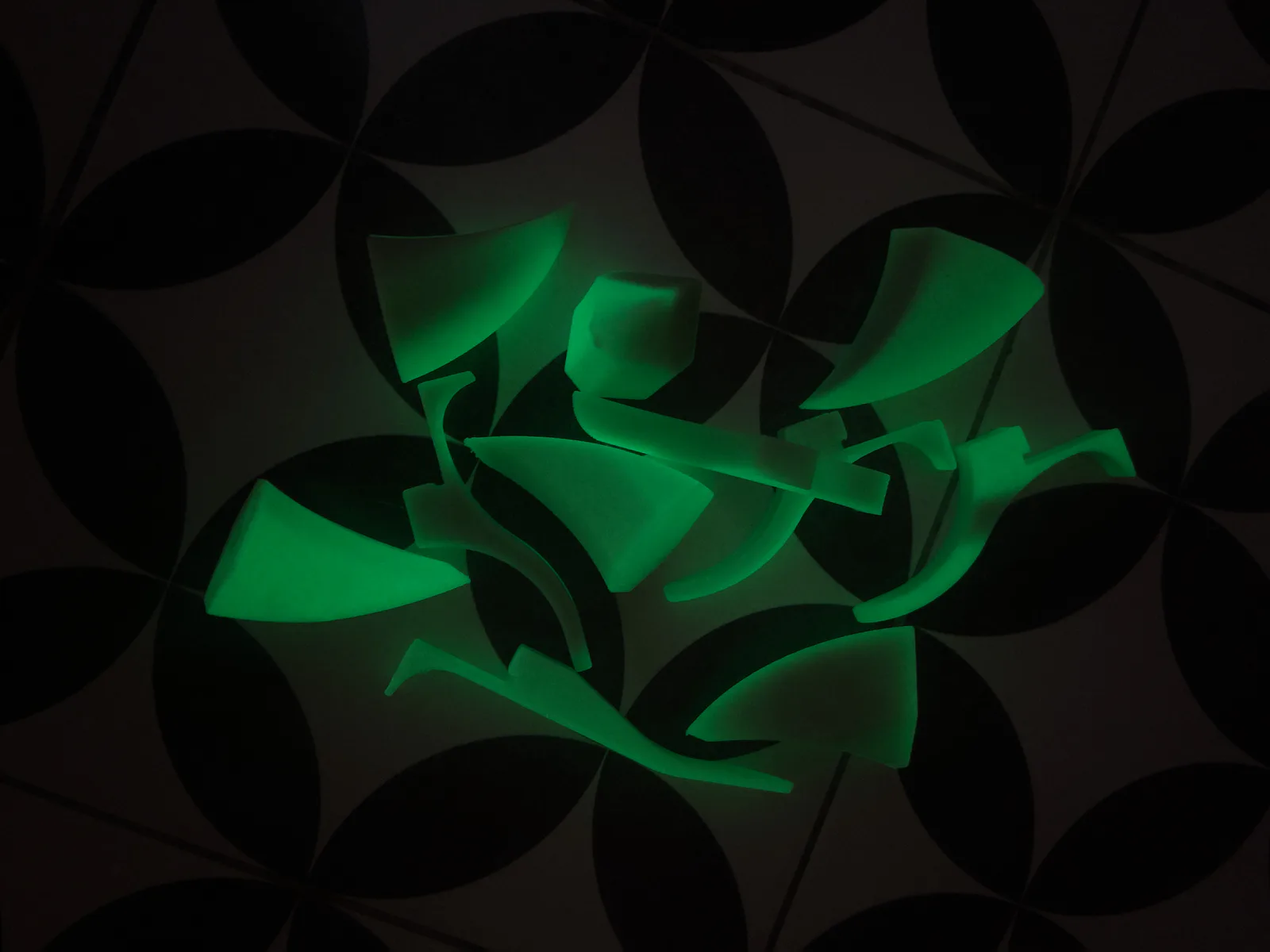
A few parts I printed from the photoluminescent PETG Ultraglow, the idea being that the object charges in the sun over the day and then glows for the "advertised" six to eight hours after dark. In reality, though, the sky darkens rather slowly. The material gives off light through the whole dusk, so by the time it is properly dark, most of the reserve is gone and the glow does not last long. Talking with the other participants, we hit on another way to absorb light even at night. Since the object emits light itself, some of that energy can be continuously absorbed back. The material then returns the light in its phosphor green, which is something I would like to explore further in the next iteration.
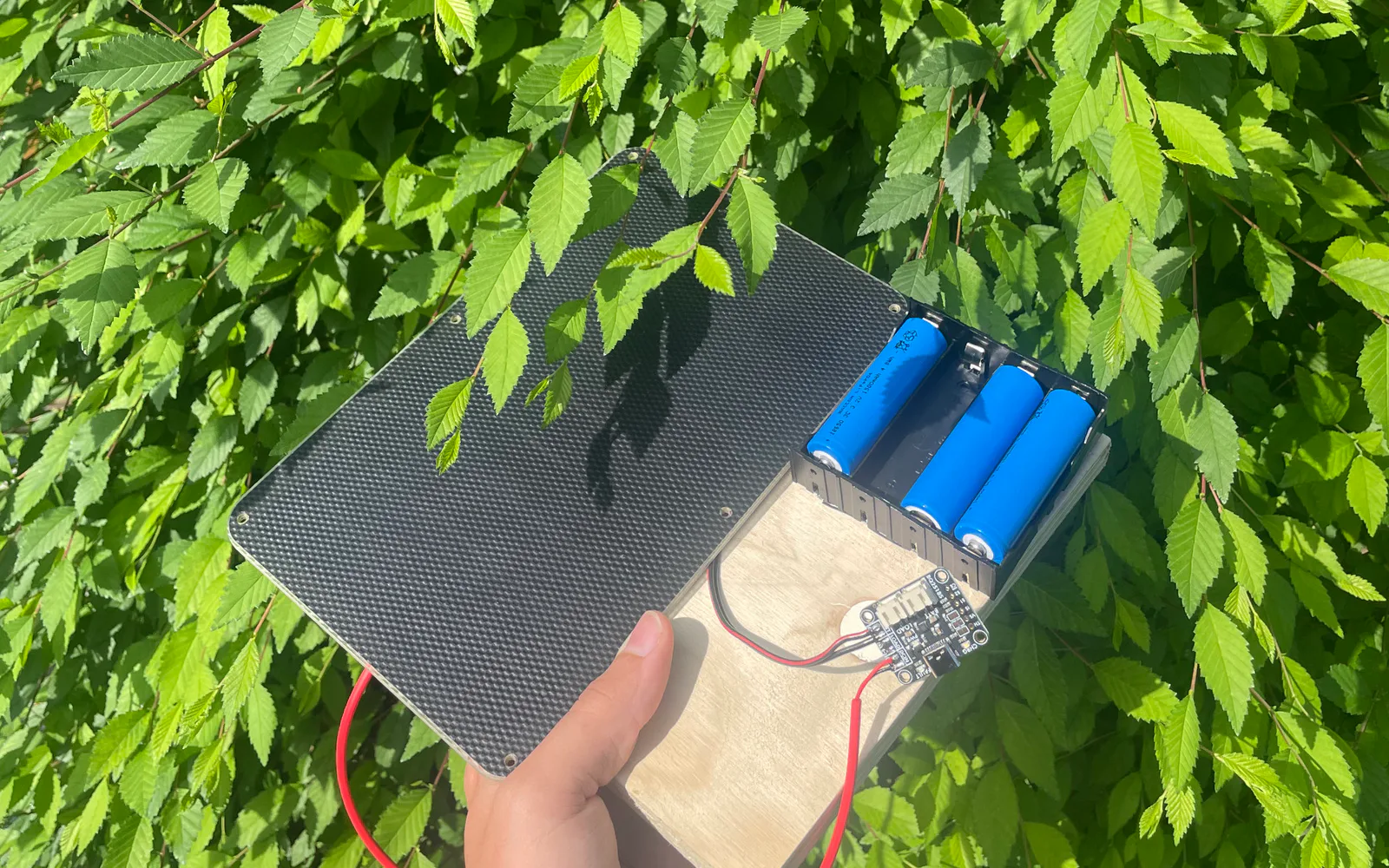
Solar !
For the first time I worked with a solar panel, a charging module and LiFePO4 cells. Charging ran reliably even with three cells instead of the planned four, but the weak point was consumption. In practice the object drew a lot even at rest, and with the high-power LEDs on, the draw climbed further still. The cells drained fast and would certainly not have lasted a whole night of running. In the next version I want to raise the capacity, program a more efficient behaviour, and finish proper mains power, so a permanent installation could run without trouble.
The high draw was also behind the microcontroller restarting on its own during testing. When all the light sources came on at once, the input voltage most likely started dipping because of the charger's current limit. Luckily, wiring the step-up converter straight to the battery and adding a capacitor solved it.
Sensing
The little mmWave radar was a great joy. One of the few sensors that can read through a wall. It picked up the presence of people (or animals) reliably over several metres, and in a camp full of people it basically always had something to read. I also managed to wire up further sensors for temperature, humidity and light intensity. For now they did not shape the object's behaviour much, but the data flowed the whole time and in future I want to work with them more.
The current perceptual system:
  INPUTS
  geophone . . . soil, ~1 m
  piezo    . . . touch, surface
  radar    . . . presence, m
  climate  . . . temp, humidity, lux
             |
             v
      +--------------+
      |   ESP32-S3   |
      +--------------+
             |
             v
  OUTPUTS
  antennae . . . 2x PMMA rod, amber
  roots    . . . LED filaments
  speaker  . . . tones and drones
  network  . . . telemetry (OSC)

  intensity -> pitch and loudness
  proximity -> brightness and tempo
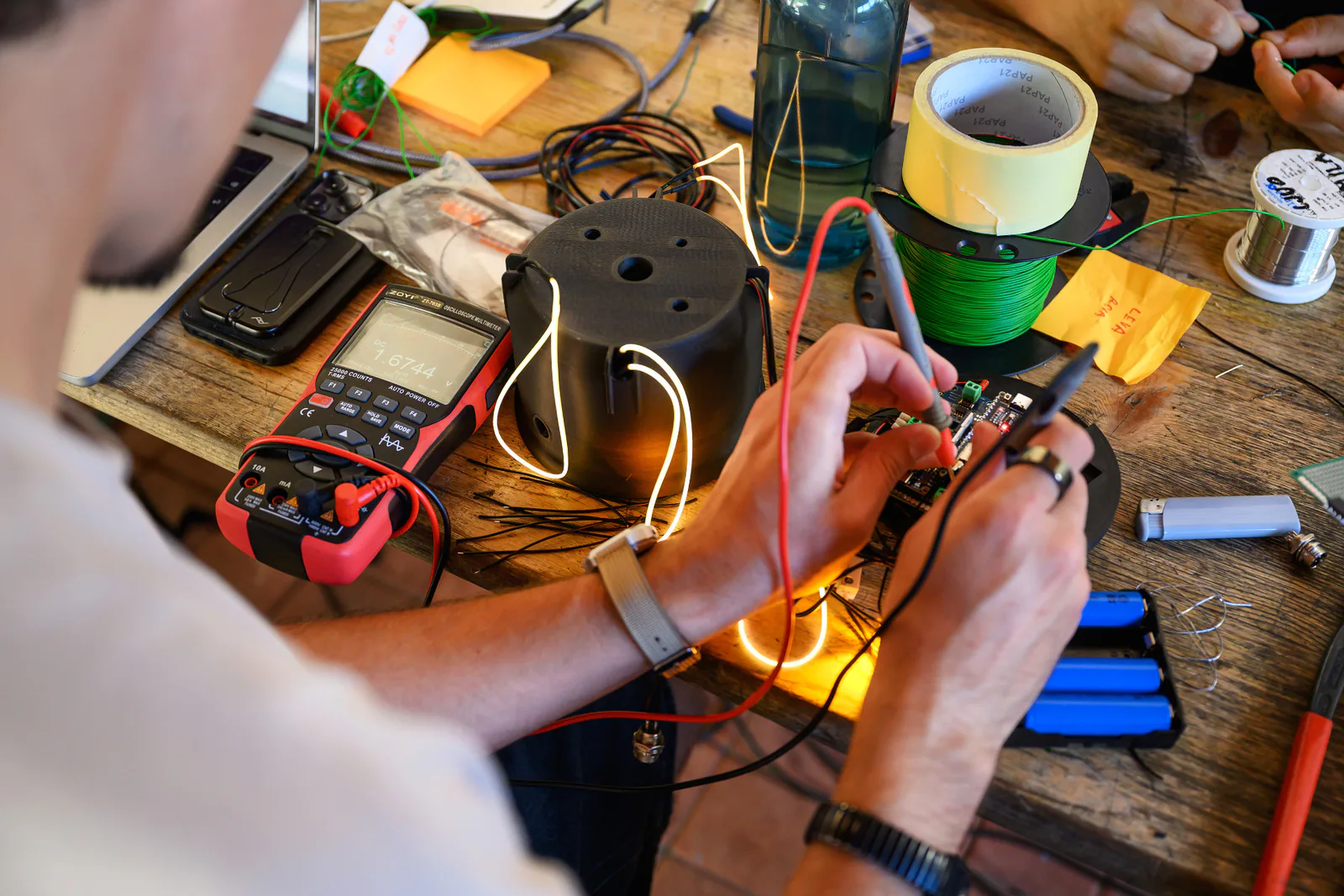
photo / Katja Goljat
Sound
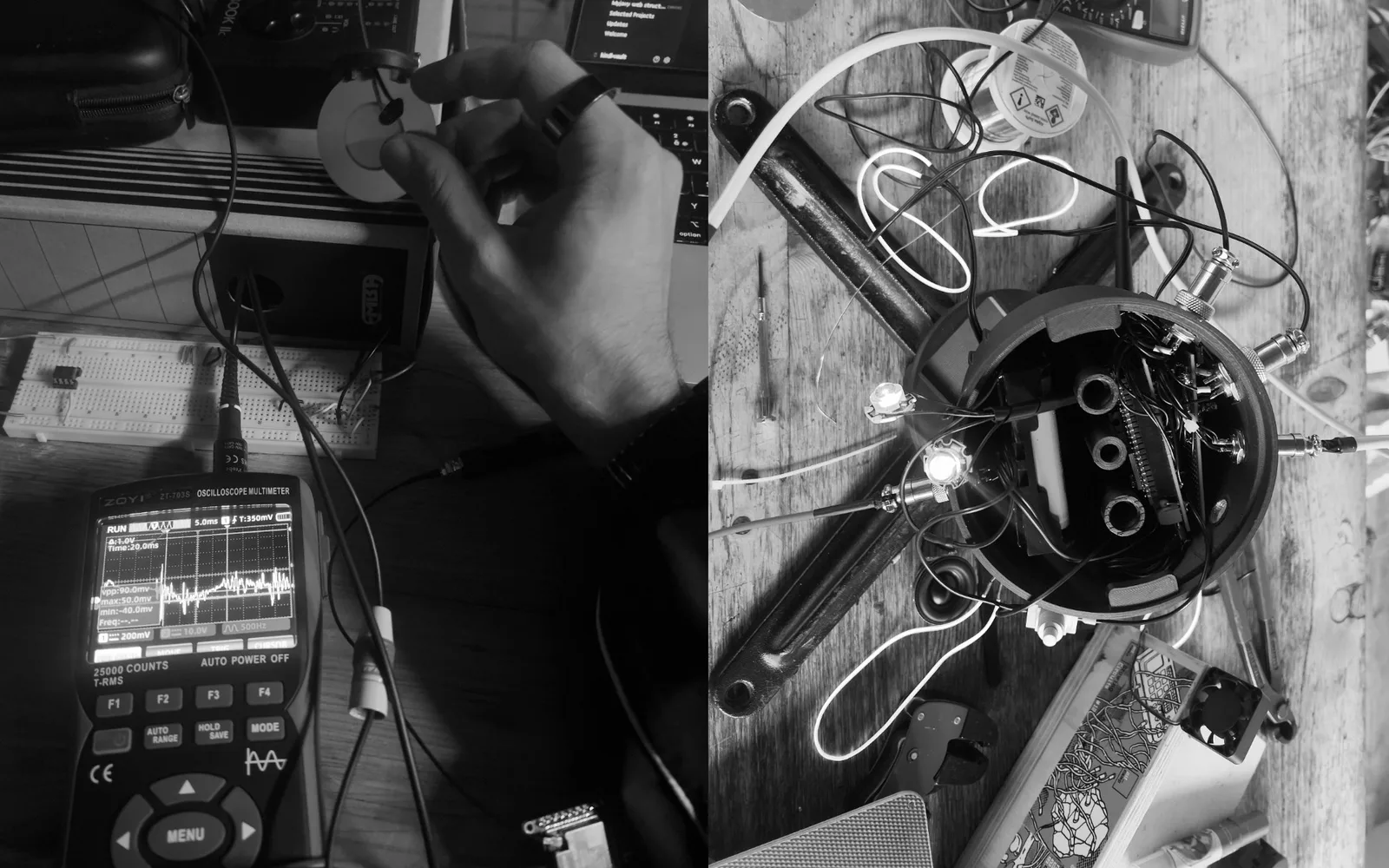
The geophone and the piezo were probably the hardest part. At first I tested them through an audio interface with its own preamp, and after denoising it sounded quite good. Wiring my own op-amp was more demanding, and I never got that clean sound out of it. In the end I took the audio signal from the ground primarily as intensity, and in code just translated and interpreted it into new sounds through tones, drones and more.
The geophone worked beautifully once it was a little under ground. It read footsteps and a touch of the ground reliably, with the intensity shifting the pitch of the tones, the loudness, and the light in the optical fibres. The piezo I did not use that much in the end, even though it picked things up decently on its own. Next time I plan to stick it straight onto the body of the object and read its own vibrations. A touch on a fibre or trembling in the wind carries through the body and can be read directly, with no capacitive sensor. The object would then be listening to itself, which actually suits it much better (a similar logic to how Host reads the vibration of its servos).
Network
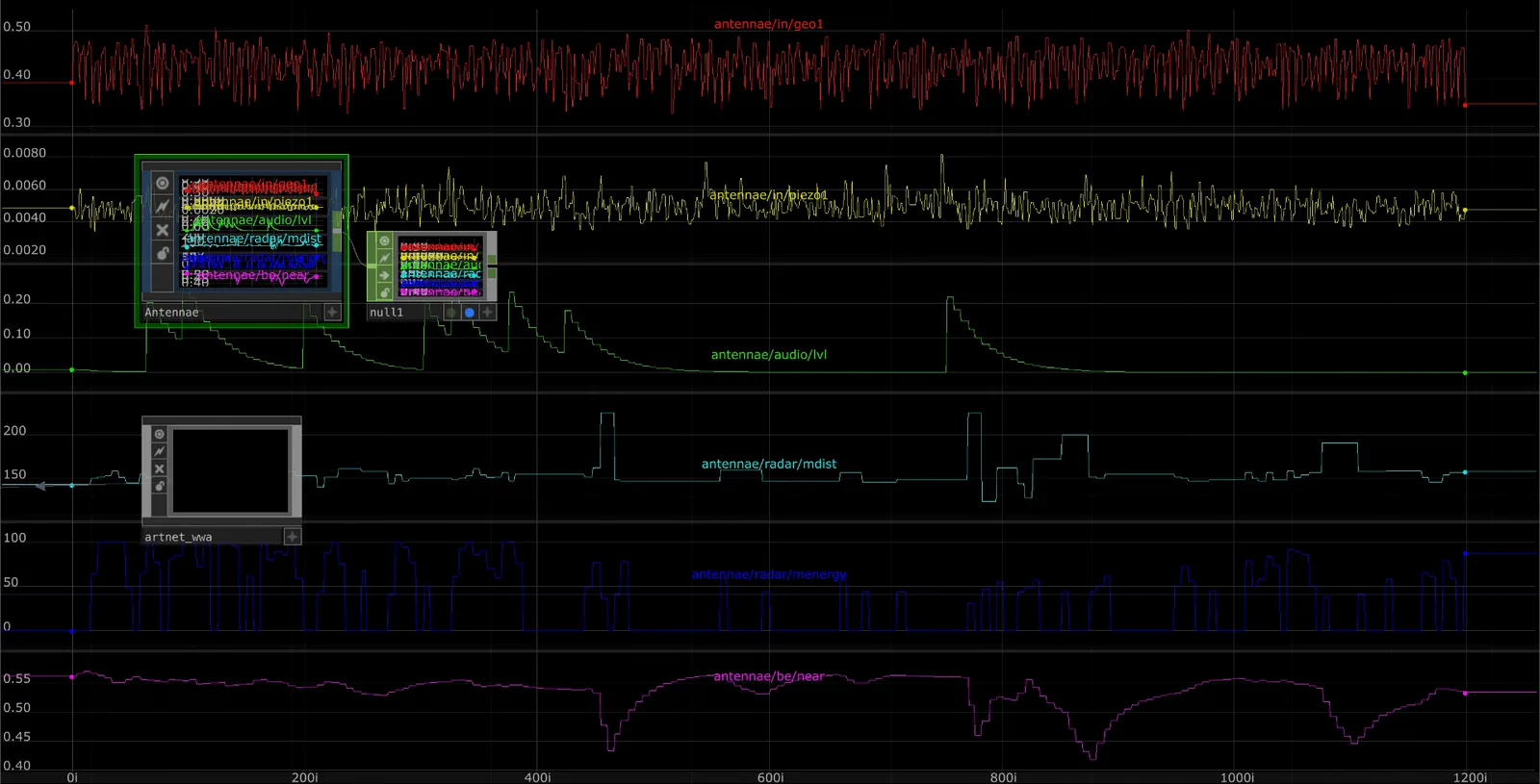
The object runs its own WiFi (AP) and streams telemetry non-stop, so I could connect to it at any moment and read what it was doing and what was happening around it. I built a web interface for it where everything could be tested and watched. On top of that it can take new firmware over the air, with no need to pull the controller out of the enclosure. In future I would like to see dozens of such units in the landscape, passing information between themselves and forming a shared technological (eco)system.
Under the Tree
After dark I set the object up under a tree and added a length of LED strip nearby, so the place would draw attention to itself. I do not want that in the future, but for one evening it served well. The radar meanwhile measured how far people were standing, and whoever came closer set the light circling the tree faster, whoever stayed back left it just slowly pulsing. The light the object gives off is deliberately amber, since it is bearable deep into the night and attracts a minimum of night insects.
In the end it once again stood on interaction. The installation kept pulsing, and whoever came closer, touched the ground or moved around it could watch the object's behaviour change and see how the system interprets their input. Even when nobody was interacting with it, though, the geophone would register occasional tremors in the soil, and the object naturally responded to that too. Whether that was a real input or just stray noise, we will leave for another time. For now I am glad the object made it through testing and is ready for the next phase.
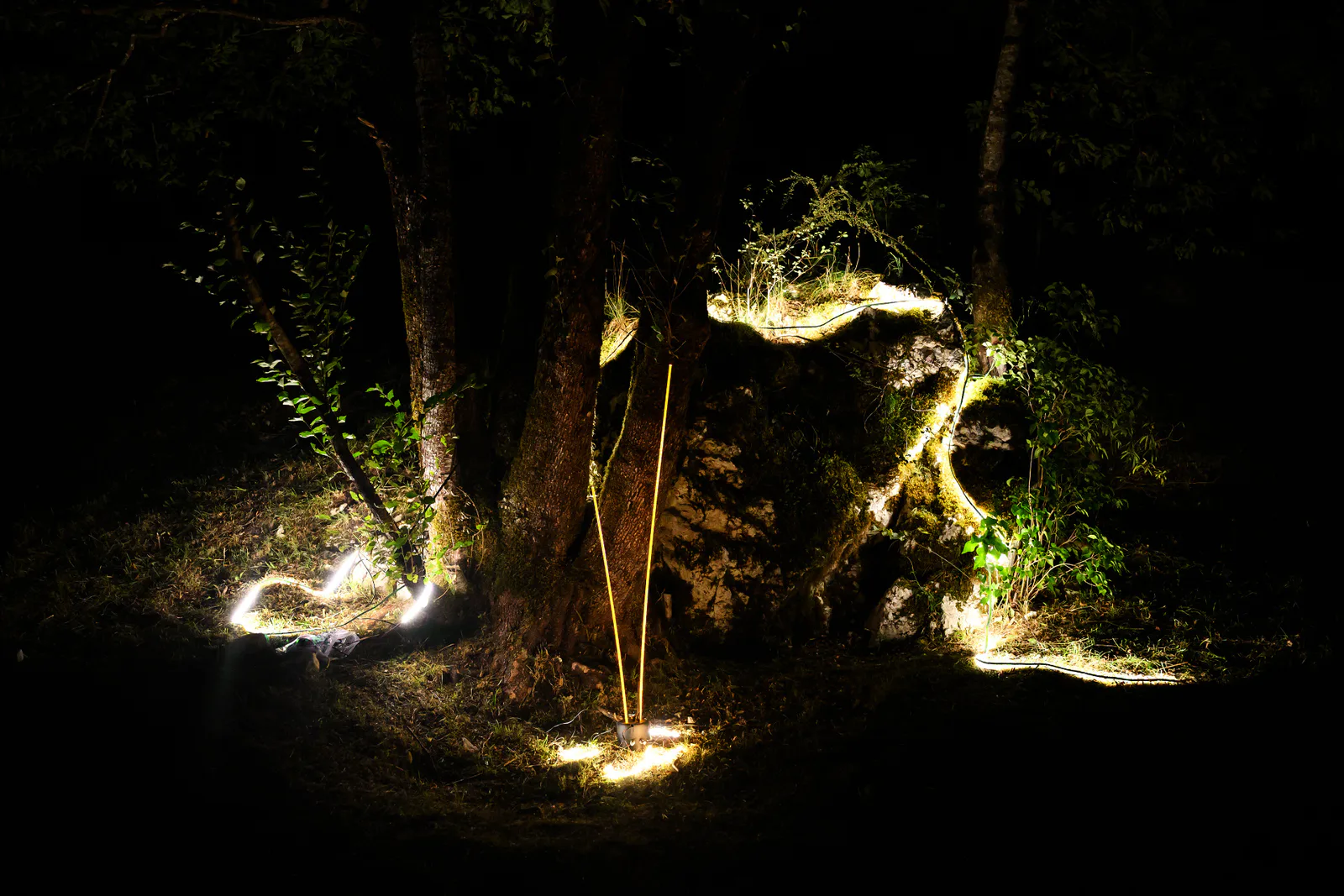
photo / Katja Goljat
The whole week was one of a kind, mainly thanks to the people. A group came together that bends technology its own way, gives it new purposes and, above all, keeps making things. I am grateful for that community dimension, because it managed to kick off further shared projects right away, and I am looking forward to those.
Resources
- HOW TO SEE LIKE A MACHINE: Trevor Paglen / on computer vision and visual perception
- I have started developing my own hardware and software for driving LEDs, and so far it looks very promising. If the underlying method interests you, it is described in this article by PJRC. More soon!
- J-Space (Anthropic) / Anthropic described a global workspace inside a language model, one they call J-space. It is an intermediate computation written in words that the model keeps for every position in the text. An interesting step in interpreting language models.