System_Adaptivity Theory
Resources: The Surprising Creativity of Digital Evolution Karl Sims System - Okruh 02 System_Evolution Theory A-Volve - Christa Sommerer and Laurent Mignonneau Manifesto of Machinism David Rokeby System_Teorie Okruhy
Využití kybernetických principů a adaptivního chování v interaktivních dílech
Využití kybernetických poznatků a teorie systémů v interaktivních uměleckých dílech. Příklady autorů a jejich projektů, kteří pracují s vývojem chování a adaptací na podněty z prostředí. Technologické strategie implementace adaptivity, zpětné vazby, senzorických systémů a algoritmů umožňujících samostatné rozhodování.
Adaptivity in the Interactive Art Using cybernetic knowledge and systems theory in interactive artworks. Examples of artists and their projects working with behavioural development and adaptation to environmental stimuli. Technological strategies for implementing adaptivity, feedback, sensory systems and algorithms that enable autonomous decision making.
Digital, Software Systems
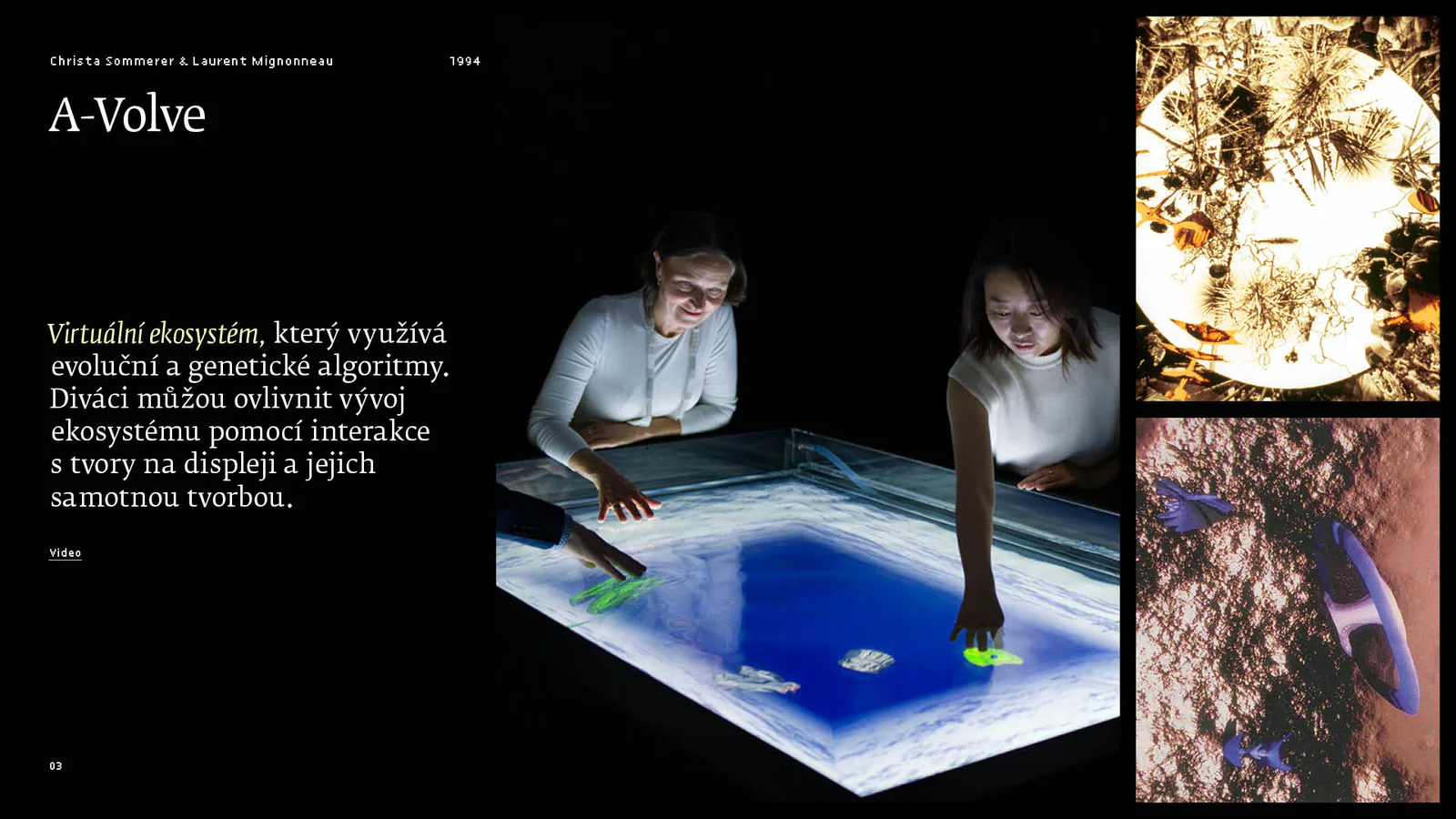
A-Volve
Christa Sommerer & Laurent Mignonneau, 1994
A virtual ecosystem that employs evolutionary and genetic algorithms. The audience can influence its development through interactions with on-screen creatures and their own creative input.
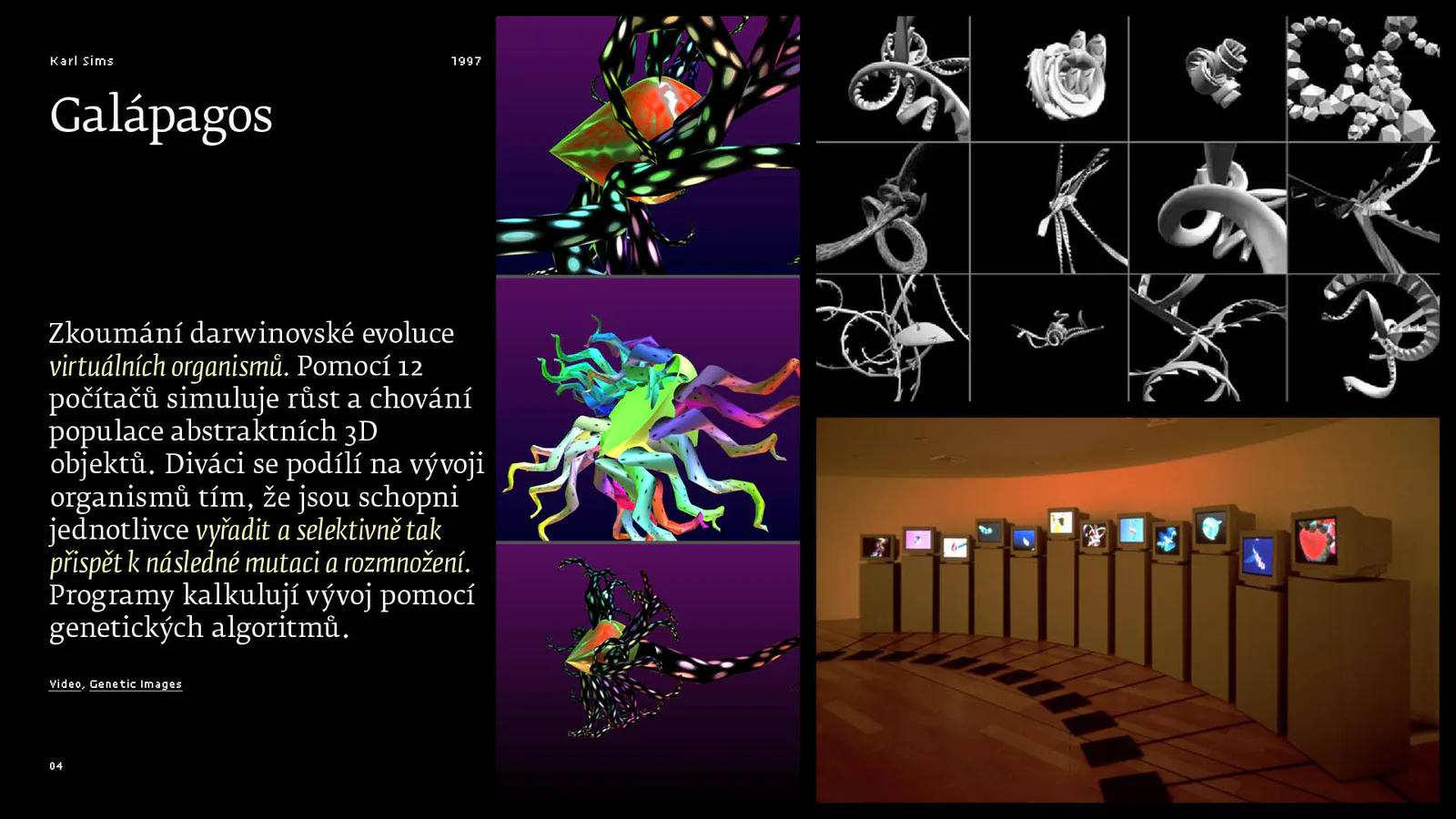
Galápagos
Karl Sims, 1997
An exploration of Darwinian evolution in virtual organisms. Twelve computers simulate the growth and behavior of abstract 3D objects. Viewers participate by selectively removing individuals, thereby influencing mutation and reproduction through genetic algorithms.
Physical, kinetics, robotics

Musicolour System / The Colloquy of Mobiles
Gordon Pask, 1953–1957 & 1968
One of the first cybernetic artworks, Musicolour was a sound-controlled installation that used an analog computer to generate lighting patterns in response to a live musician. Later, it evolved into The Colloquy of Mobiles, where kinetic modules mimicked an incantatory ritual, allowing viewers to interact via light.
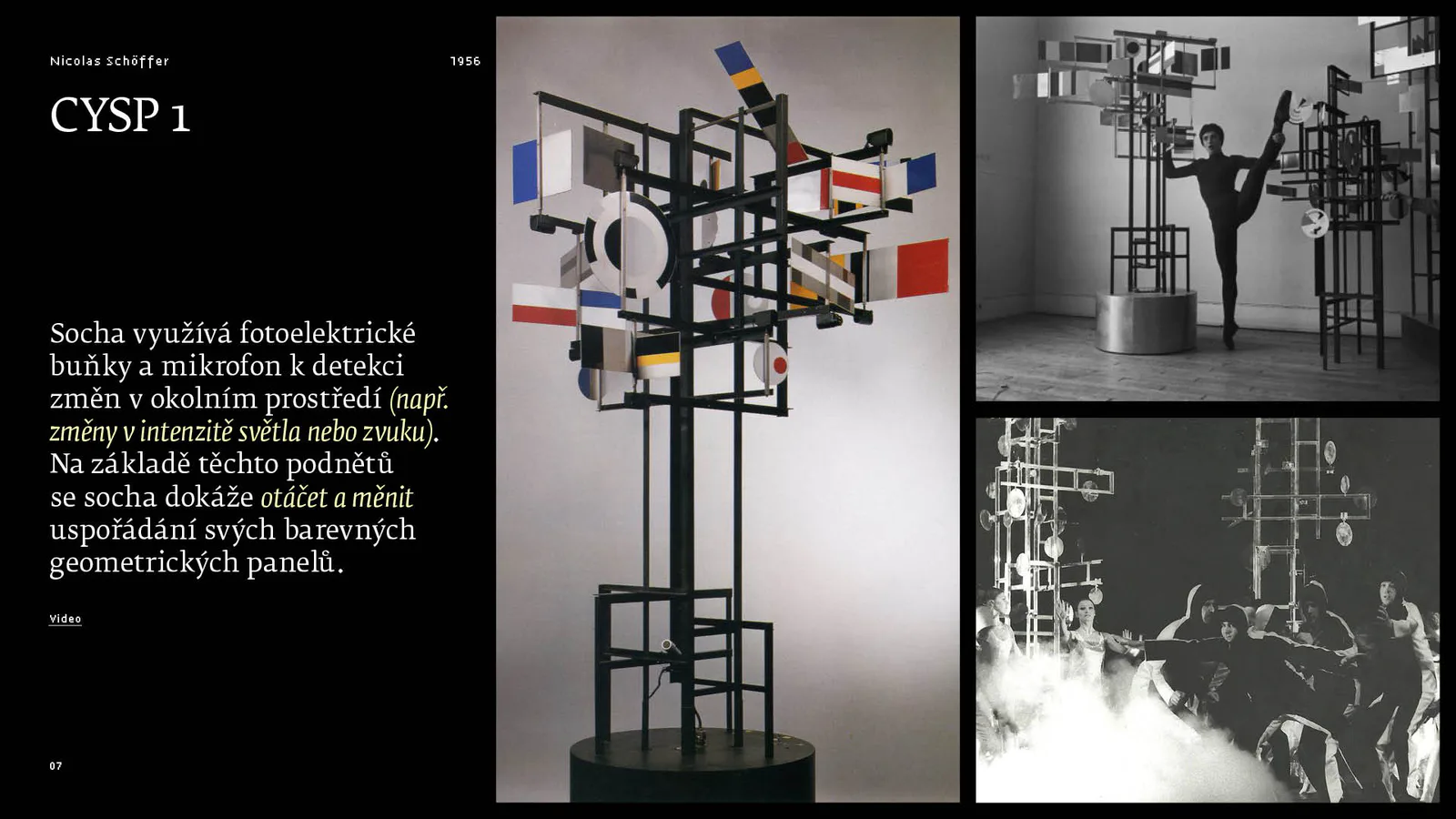
CYSP 1
Nicolas Schöffer, 1956
A sculpture that uses photoelectric cells and a microphone to detect environmental changes—such as variations in light intensity or sound. In response, it rotates and reconfigures its colorful geometric panels.
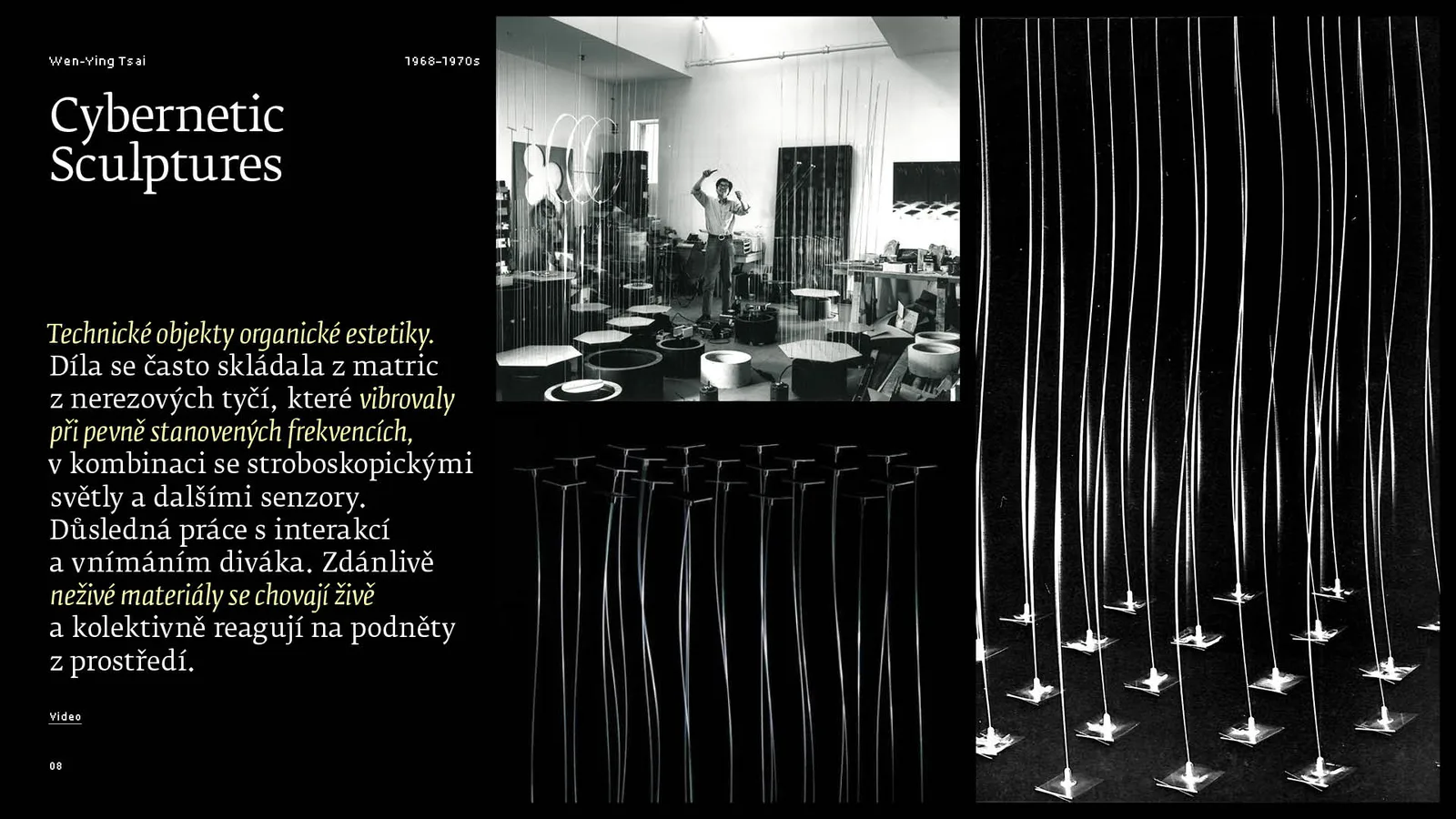
Cybernetic Sculptures
Wen-Ying Tsai, 1968–1970s
Technical objects of organic aesthetics, these works typically consist of stainless steel rod matrices that vibrate at fixed frequencies, combined with stroboscopic lights and sensors. Through careful interaction design, inanimate materials appear to behave in a lifelike, collective manner.
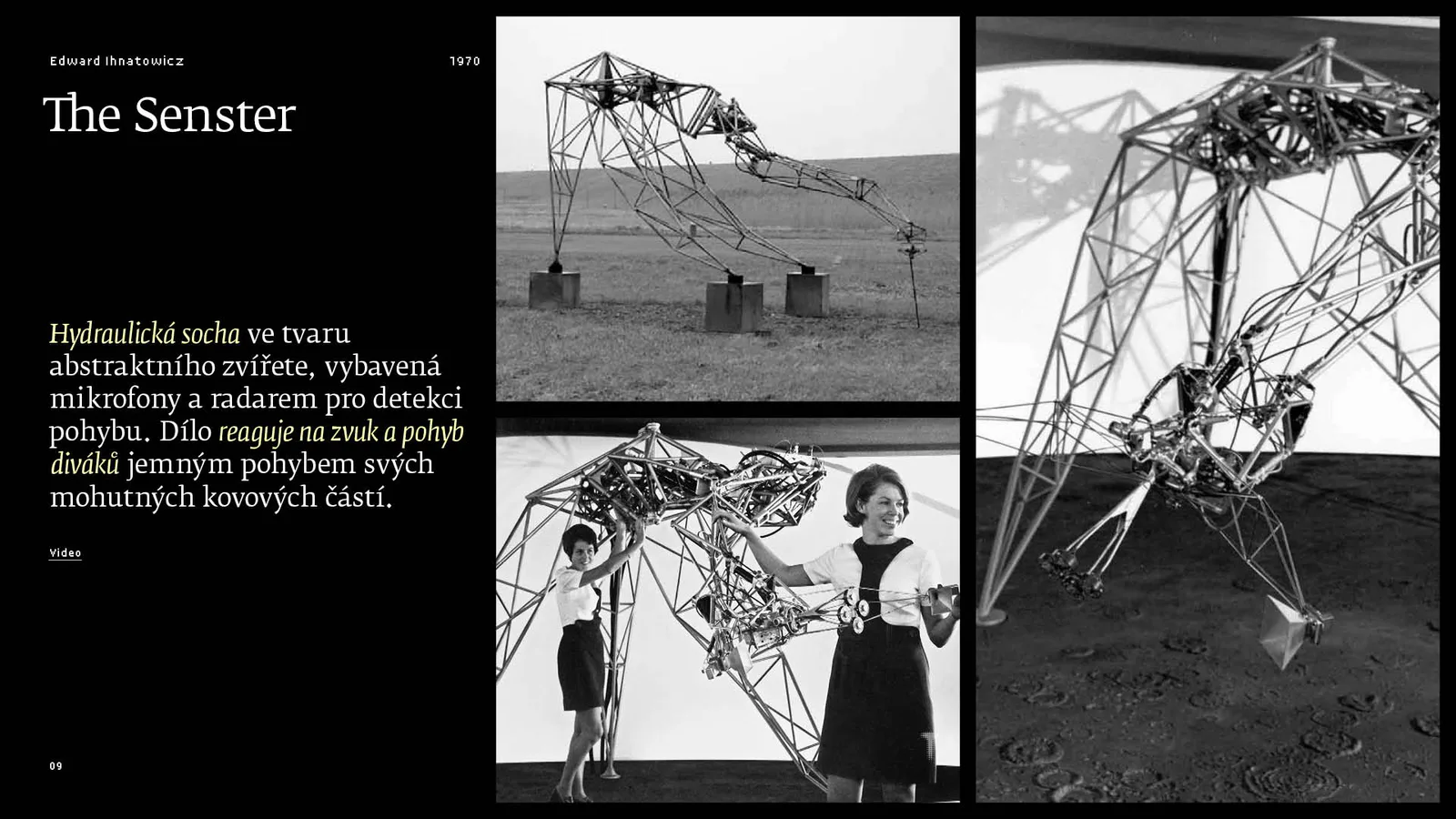
The Senster
Edward Ihnatowicz, 1970
A hydraulic sculpture in the form of an abstract animal, equipped with microphones and radar to detect movement. It responds to sound and viewer motion with subtle shifts in its robust metal components.
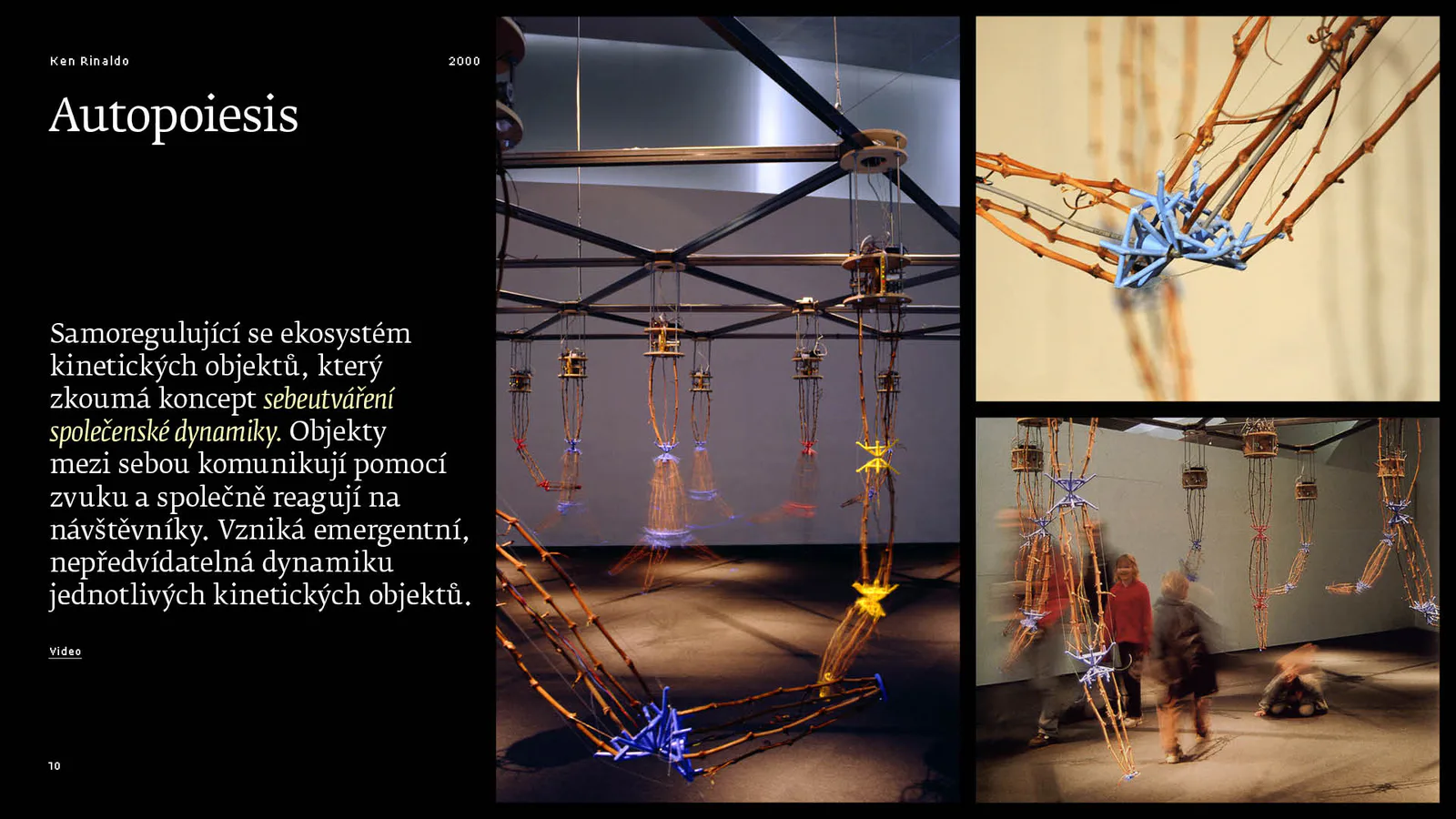
Autopoiesis
Ken Rinaldo, 2000
A self-regulating ecosystem of kinetic objects exploring autonomous societal dynamics. The objects communicate through sound and collectively respond to visitors, creating emergent and unpredictable behavior.
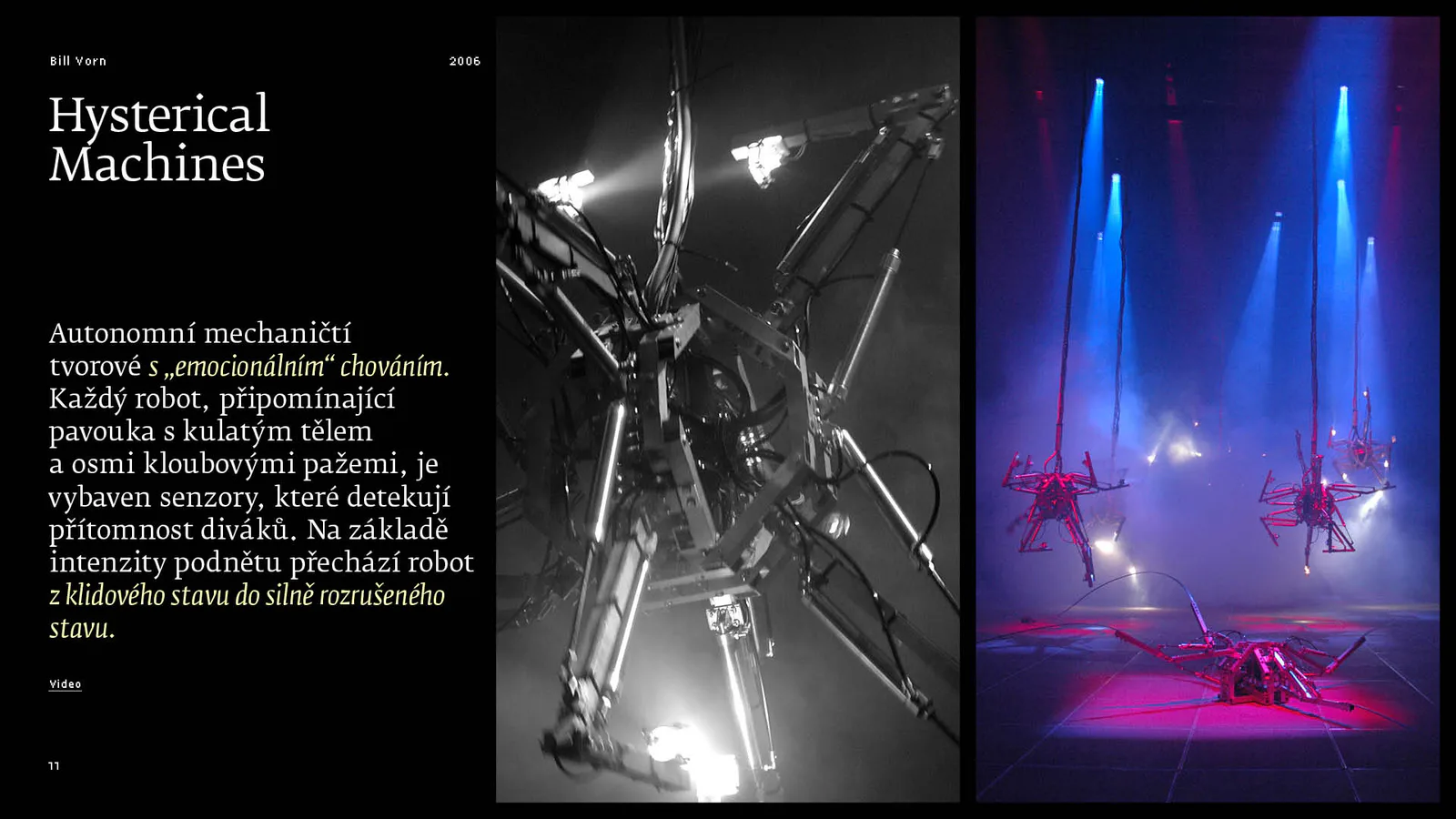
Hysterical Machines
Bill Vorn, 2006
Autonomous mechanical creatures with “emotional” behavior. Each robot, resembling a spider with a rounded body and eight jointed arms, is equipped with sensors that detect viewers, shifting from a state of rest to heightened agitation as stimulus intensity increases.
Bio-Cybernetics
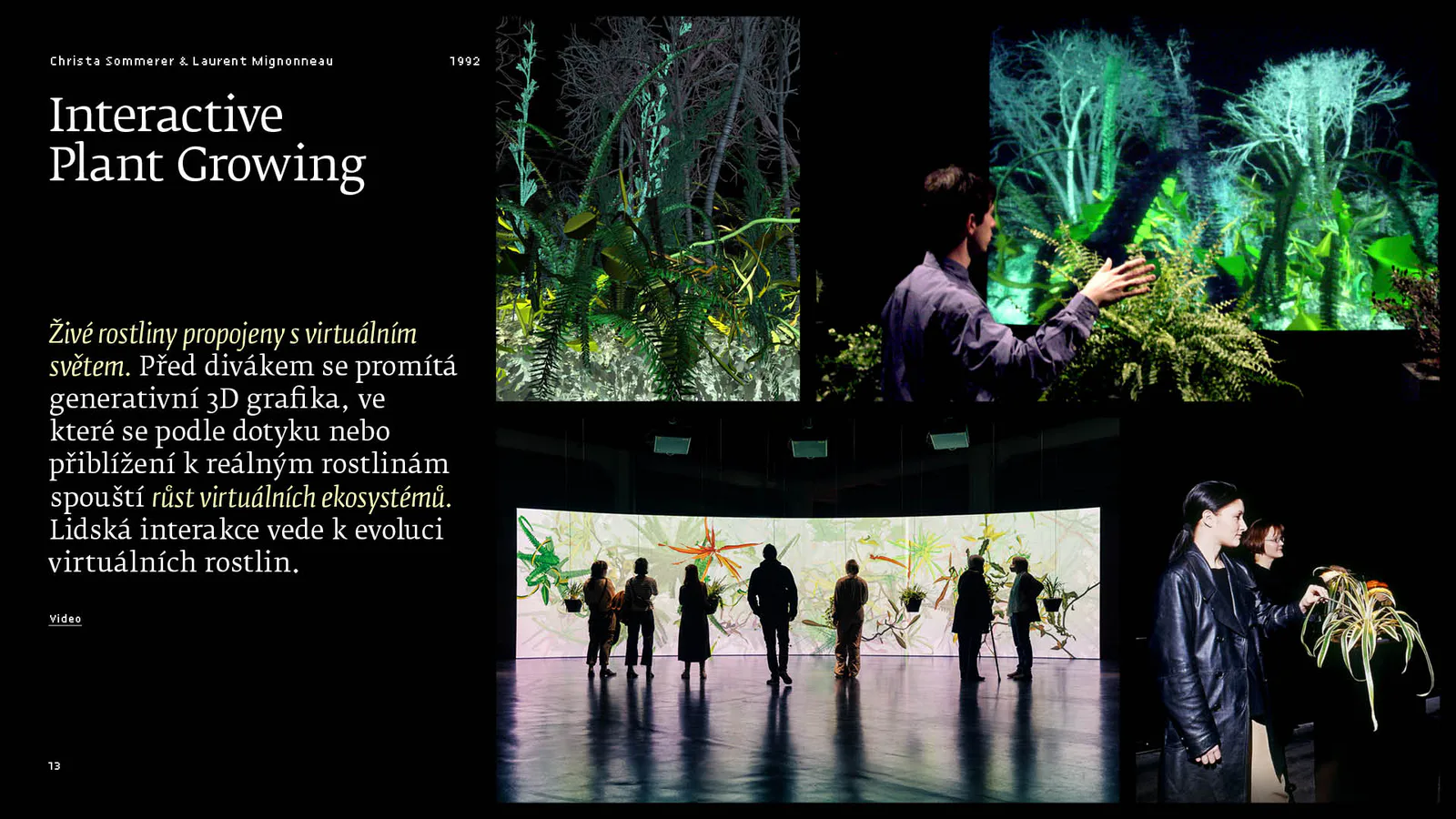
Interactive Plant Growing
Christa Sommerer & Laurent Mignonneau, 1992
Live plants integrated with a virtual world. Generative 3D graphics are projected, where touch or proximity to real plants triggers the growth of virtual ecosystems. Human interaction drives the evolution of these digital flora.
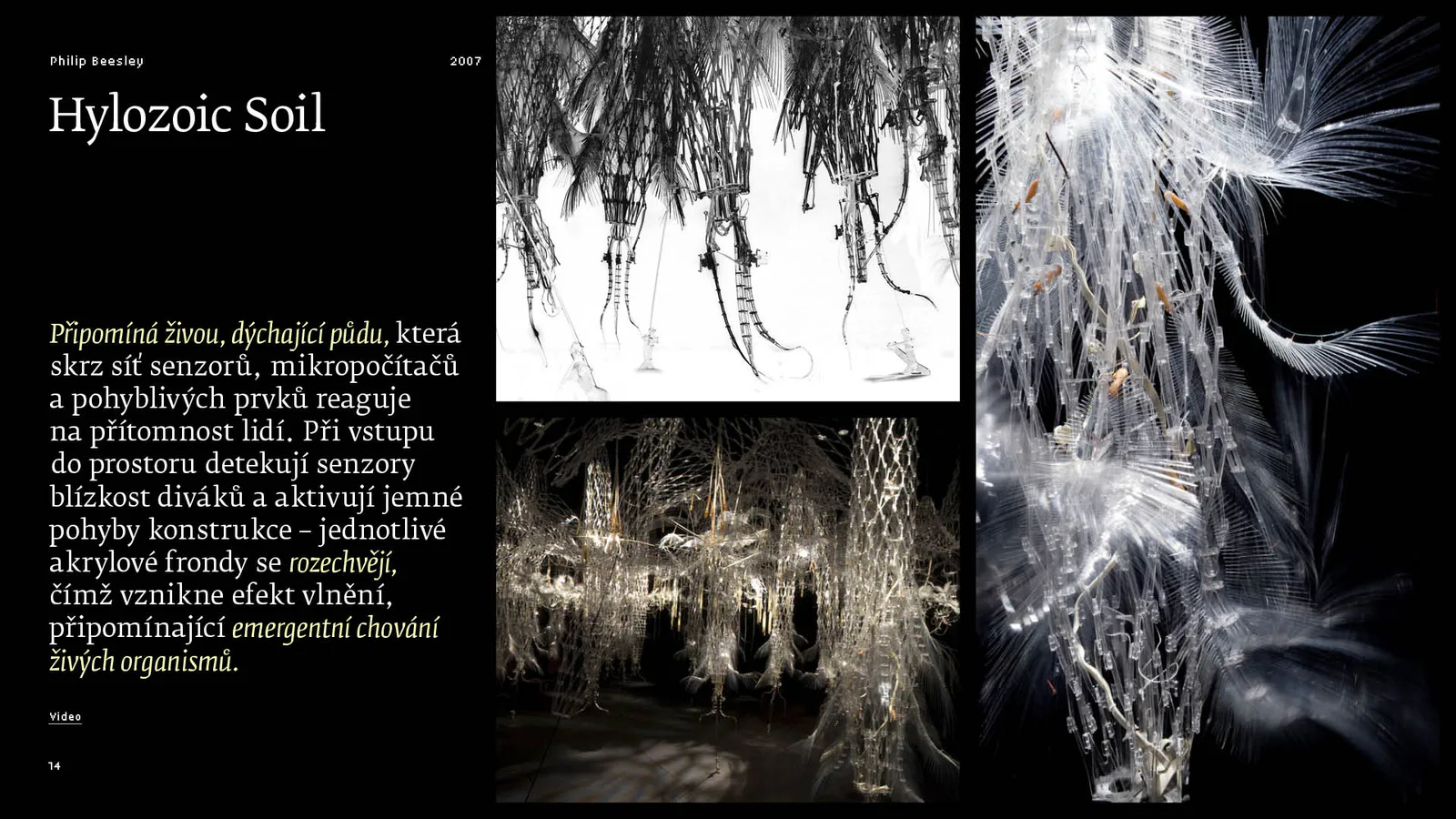
Hylozoic Soil
Philip Beesley, 2007
It evokes living, breathing soil that, through a network of sensors, microcomputers, and moving components, reacts to the presence of people. As viewers enter the space, sensors detect their proximity and activate subtle movements in the structure—individual acrylic fronds tremble, creating a ripple effect reminiscent of living organisms.
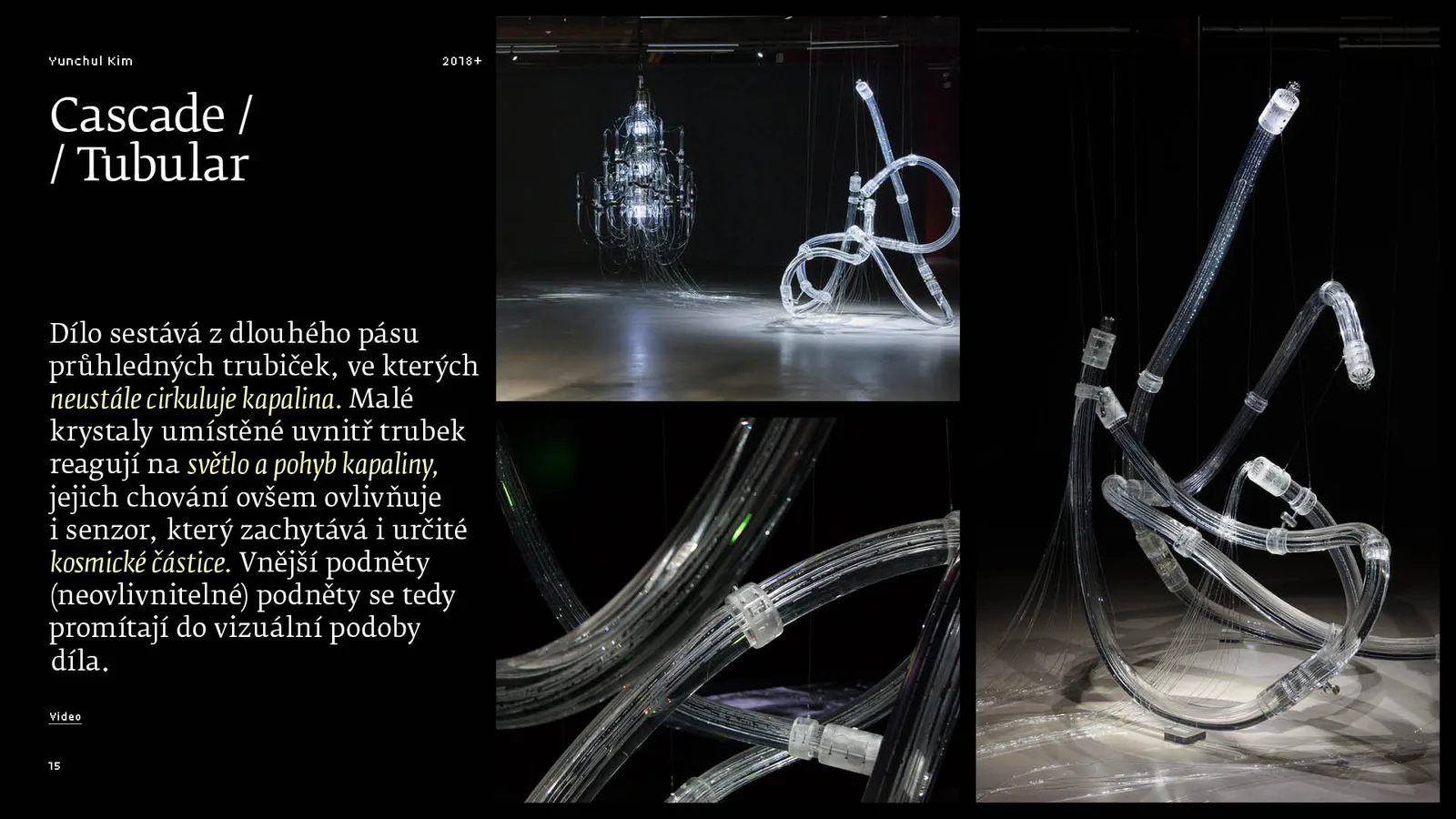
Cascade / Tubular
Yunchul Kim, 2018+
An artwork composed of a series of transparent tubes through which fluid continuously circulates. Small crystals inside respond to light and fluid motion, with their behavior also influenced by sensors detecting cosmic particles. Uncontrollable external stimuli are transformed into the visual language of the piece.
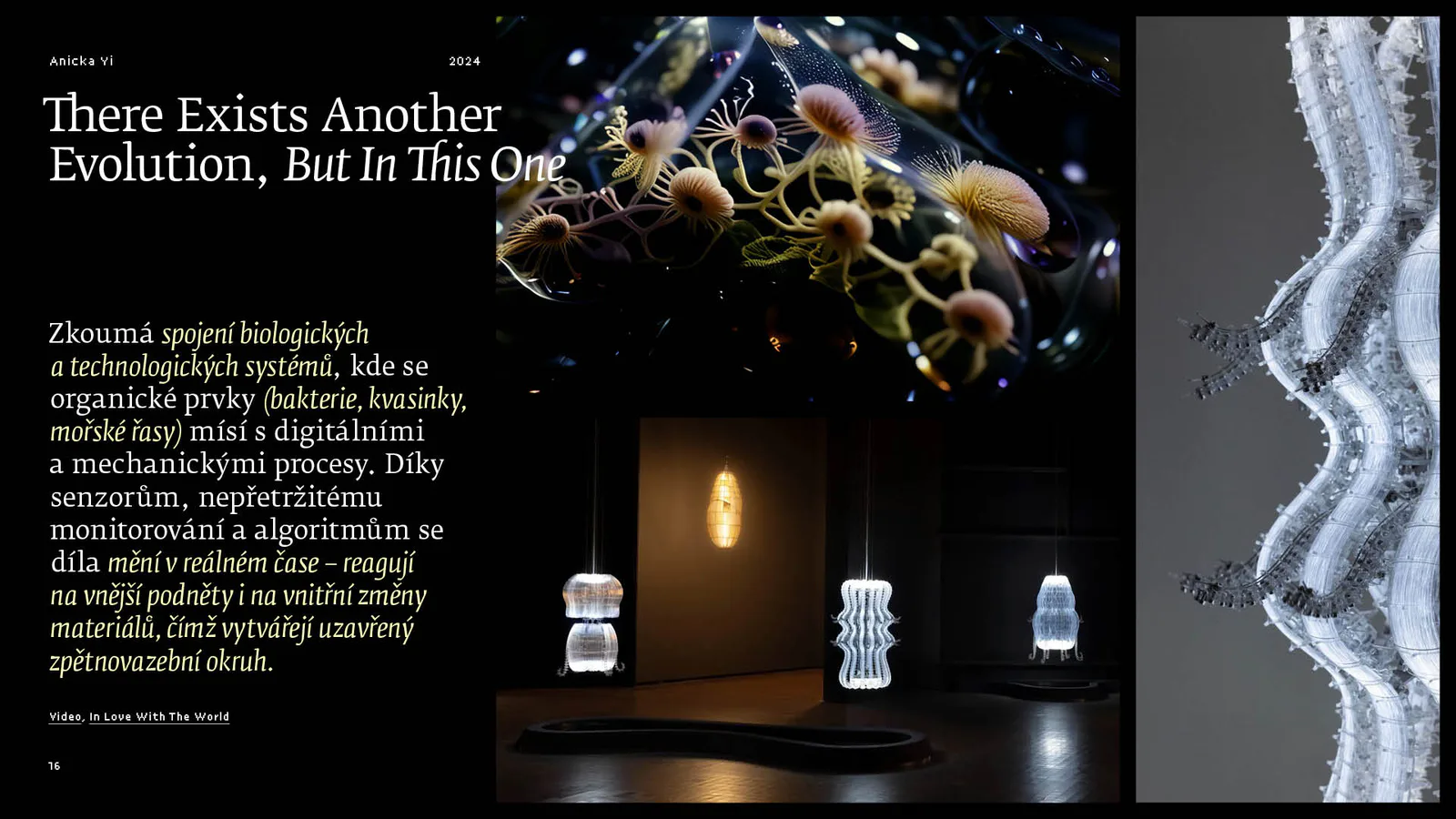
There Exists Another Evolution, But In This One
Anicka Yi, 2024
An exploration of the integration between biological and technological systems, where organic elements—such as bacteria, yeasts, and seaweeds—merge with digital and mechanical processes. Through sensors, continuous monitoring, and algorithms, the artwork transforms in real time in response to both external and internal stimuli, creating a closed feedback loop.
Instalation / Performance
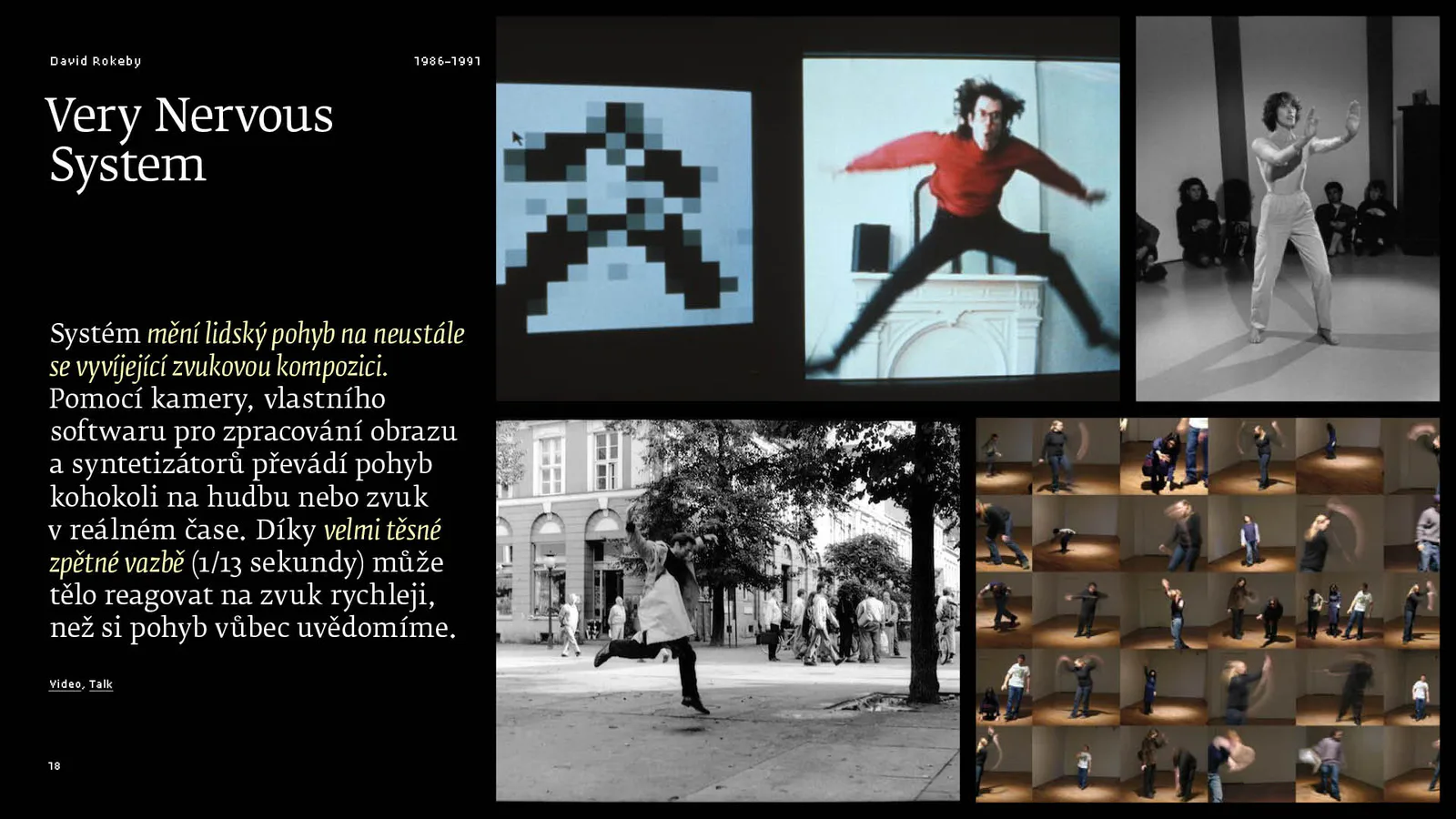
Very Nervous System
David Rokeby, 1986–1991
A system that transforms human movement into an ever-evolving sound composition. Utilizing a camera, custom image processing software, and synthesizers, it converts any movement into music in real time. With an ultra-tight feedback loop (1/13 second), the body reacts to sound faster than the movement is consciously perceived.
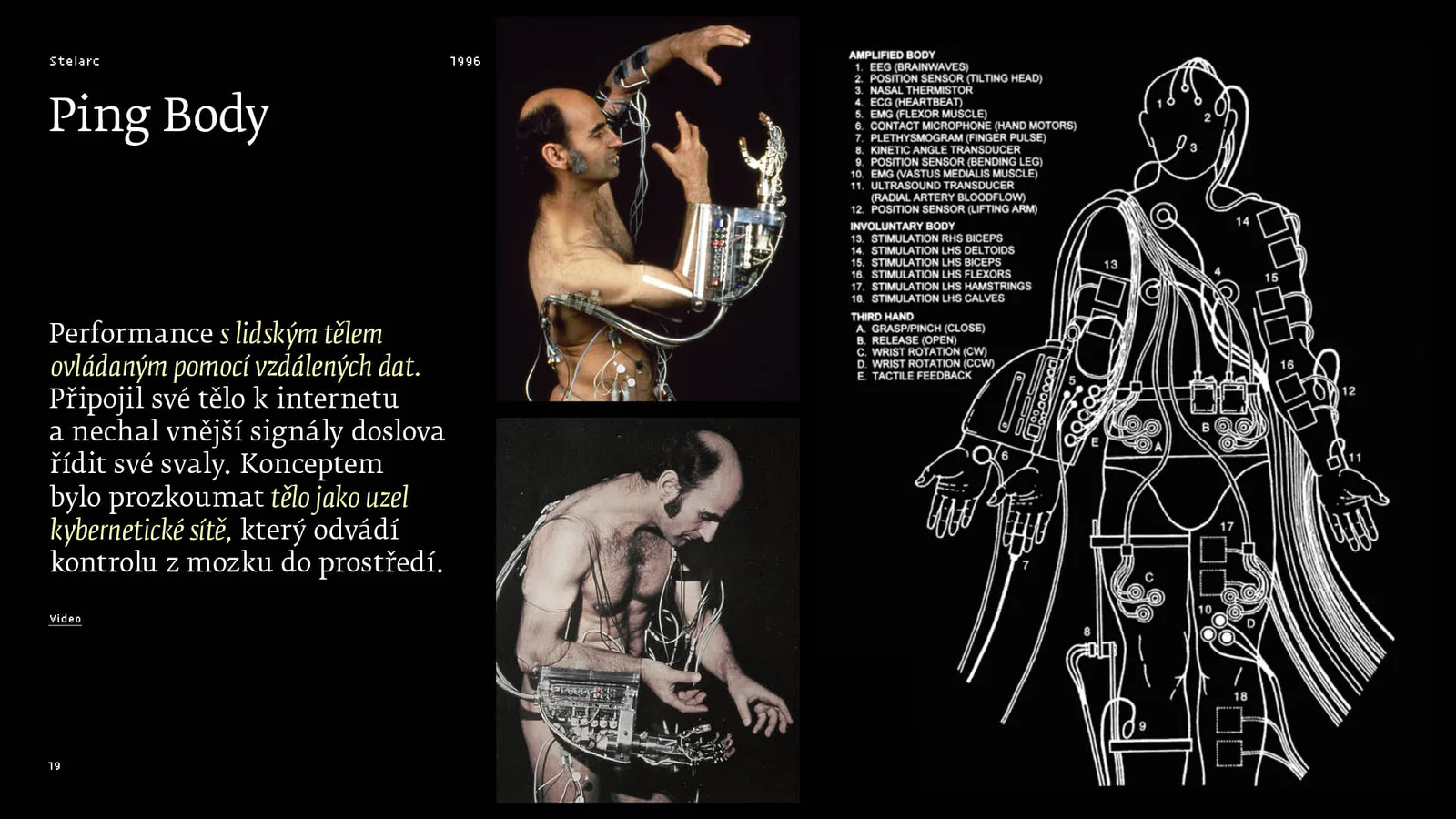
Ping Body
Stelarc, 1996
A performance in which the human body is controlled by remote data. Stelarc connected his body to the internet, allowing external signals to dictate his muscle movements. This concept explores the body as a node within a cybernetic network, transferring control from the brain to the environment.
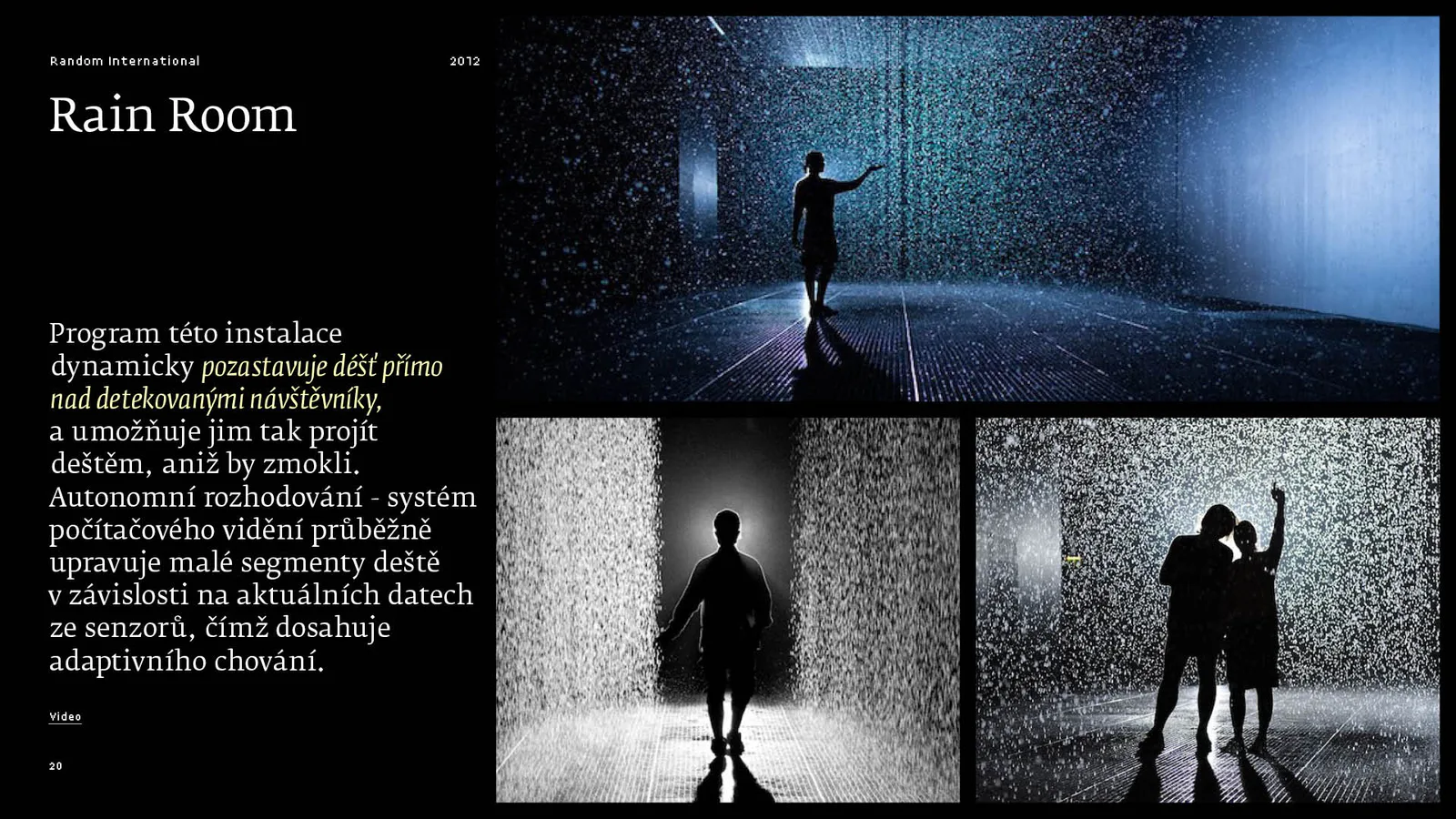
Rain Room
Random International, 2012
An installation that dynamically suspends rain directly above detected visitors, enabling them to pass through the downpour without getting wet. The autonomous computer vision system continuously adjusts segments of rainfall based on sensor data, demonstrating adaptive behavior.